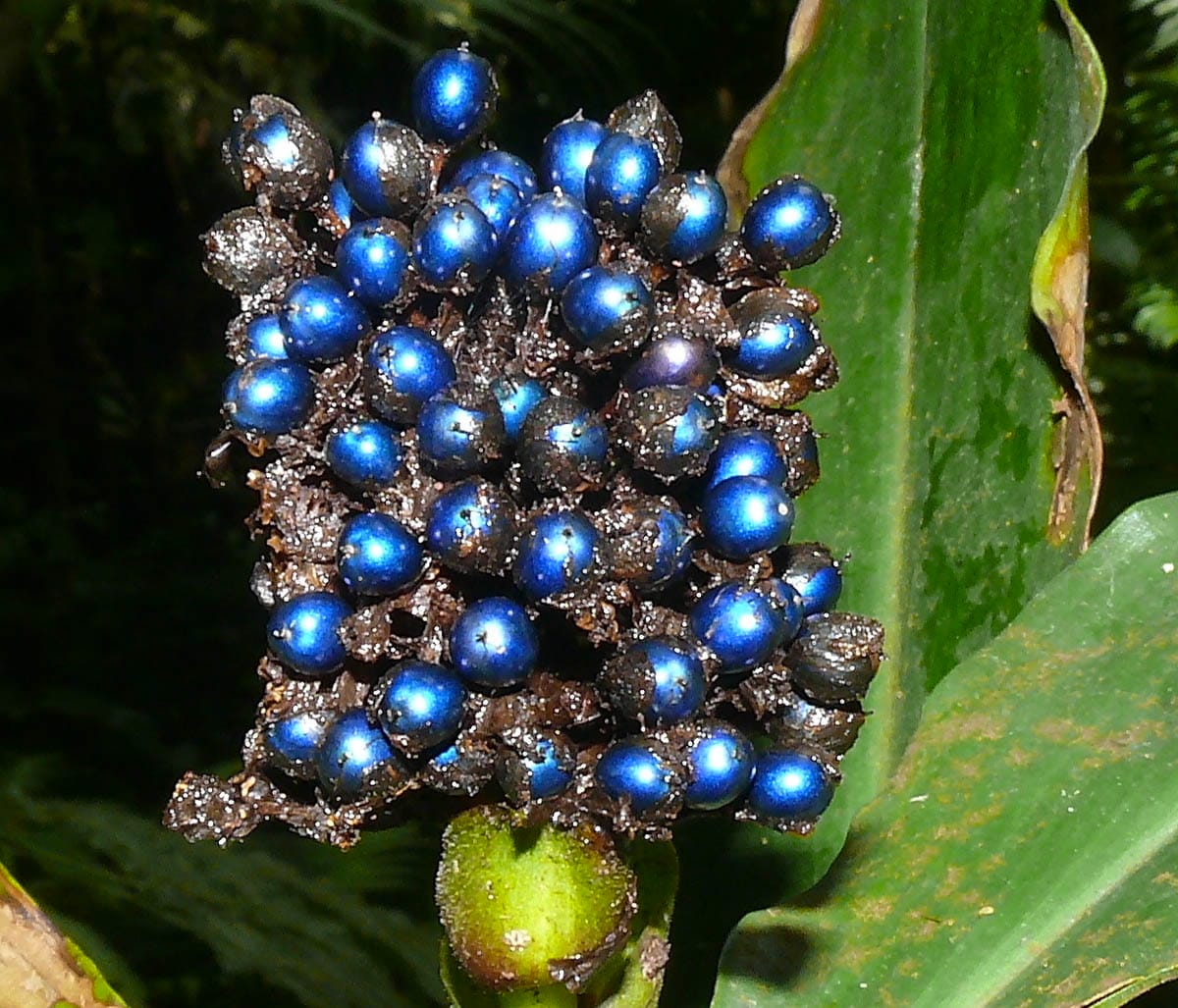
The Pollia berry has kept the most intense blue on Earth for a century in a drawer, without a single molecule of pigment. Silvia Vignolini found out how, then taught cellulose, the stuff of wood, to do the same on a factory roll. Colour you grow instead of mine, from a scientist who would rather you bought less.
Silvia Vignolini grew up in Italy, the first in her family to go to university. When she told her father she had chosen physics, he asked "to do what?", and she had no answer. In Florence the observatory courses were rained out and the optics labs had lasers to align, so the stars lost to light. A chance introduction took her to Cambridge to study the colour of flowers, a subject she first found a little silly. She stayed fourteen years, co-founded Sparxell and a second spin-out from that bench, and today directs Sustainable and Bio-inspired Materials at the Max Planck Institute of Colloids and Interfaces in Potsdam.
A pigment swallows part of the light, and because it keeps swallowing, it fades. The Pollia berry swallows nothing. Its cell walls are cellulose stacked at the nanoscale so that only one slice of the spectrum reflects back. Grind the berry and the powder is still blue, because the colour lives in the structure, not in a molecule. A soap bubble does the same; so does glitter, built from layered plastic. Vignolini's lab lets cellulose assemble itself into that architecture with nothing but water and evaporation. In 2018 that meant a few grams. In 2026 it is a lorry full.
A Wednesday afternoon in 2040, and the lab in Potsdam is full of people, which was Silvia's first hope. A student specifies a blue through an interface and the cellulose grows into it. Across the river a bridge wears a coat that turns colour where it begins to crack. On the street a jacket shifts like an octopus, grown on its owner's skin rather than dyed in a vat. Nobody calls it a miracle. The question she still asks every visitor is the one she asked us: do you need it at all? Everything is possible, she says, if we want it, and if it is useful.
Episode 3 of Grown, Not Made.